Tuesday, 15 September 2015

Flat Feet, Fallen Arches, Painful Arches


If you have flat feet (pes planus) it does not mean you will have problems or pain. Flat feet are a common condition. Flat feet are defined as an abnormal lowering of the medial longitudinal arch. There is often a hereditary component to the development of flat feet. Flat feet are more common in certain ethnic groups. Flat feet usually occurs equally in both feet and become apparent at an early age.  Flat feet can initially be asymptomatic, but can become progressively symptomatic with age. Some flat feet never become bothersome.  

The medial arch is unstable in flexible flatfoot. The foot can bend as the heel lifts of the ground. This creates stress on the surrounding soft-tissues and joints creating tired, sore arches. The instability of the foot can create abnormal stress that flows up the leg which results in pain in the legs, knees, hips and lower back.  Patients with flat feet often present to the chiropodist/podiatrist with problems that are indirectly caused by their foot structure.

Symptoms

  • Pain and stiffness of the medial arch or anywhere along the mid-portion of the foot

  • Associated discomfort within and near the ankle joint

  • The knees, hips, and lower back may be the primary source of discomfort

  • Feet may often feel tired and achy

  • Painful shin splints may develop with activity

  • Gait may be awkward.

Causes

  • Genetic predisposition

  • Faulty foot mechanics, e.g. excessive pronation

  • Abnormal bony architecture

  • Laxity of ligaments

  • Neuro-muscular disease

  • Trauma to the leg muscles or major tendons

  • Inflammatory diseases of the joints e.g. Rheumatoid arthritis

  • Surgical procedures on the leg and ankle

  • Limb length inequality

  • Tight Achilles tendon

Treatment for Flatfeet

Foot orthotic devices can stabilize some of the causes of flat feet, optimize muscle function and reduce the occurrence of painful symptoms. Generally, a custom-made semi-rigid functional posted orthotic is effective for flat feet. These devices are prescribed based on a thorough biomechanical examination by a qualified chiropodist/podiatrist. Over-the-counter arch supports may be helpful for mild cases, but often prove ineffective to relieve symptoms associated with flatfoot.

  • Wear shoes with a good fit in the arch

  • Keep active and fit to strengthen leg and foot musculature

  • Control body weight to decrease load on the feet

  • Avoid prolonged periods weight bearing with bare feet

  • Taping to support strained ligaments and joints

  • Physical therapy modalities such as ultrasound

  • Referral for surgical correction a severe symptomatic flatfoot

Complications of flatfoot over time

  • Severe heel pain from plantar fasciitis and Achilles tendonitis

  • Chronic strain and pain in the arch and lateral side of the mid-foot

  • Metatarsal stress fracture

  • Early degenerative joint disease (osteoarthritis) of lower extremity joints

  • Flatfeet are more prone to conditions such as bunions, hammer-toes, and Morton's neuroma

  • Painful corns and calluses

  • Structural changes may create areas of abnormal pressure resulting in chronic ulcers of the foot

  • Chronic foot pain may lead to inactivity and diminished well-being

Adult Acquired Flatfoot

Some people have always had flat feet from a young age. Unfortunately as people reach their fifties they will suddenly have one foot with a flatter arch than the other foot. This situation is termed adult acquired flatfoot. Adult acquired flatfoot is a painful condition occurring in one foot. The common patient profile is a female over the age of 50 with pre-existing flatfeet, high blood pressure, high cholesterol, diabetes and obesity. All of these underlying problems will lead to a weakening of the support structures of the arch. If you have adult acquired flat foot you will not be able to lift your heel off the ground while standing on one leg.

Adult acquired flatfoot may develop due to trauma or degeneration of major tendons ankle & foot. Weakness or paralysis of leg muscles can also create a flatfoot deformity.

Adult acquired flat foot can be treated with:

1. physical therapies,
2. motion control running shoes or hiking boots,
3. custom foot orthoses, and
4. ankle foot orthoses.


Call for Appointment: 91 9029022848


Resource:
Flat feet, fallen arches, painful arches treated by chiropodist foot doctor in Whitby, Peterborough

High arched feet


If you have feet with a high arch or instep while standing, you have foot condition called pes cavus. The arch, or instep, runs from the toes to the heel on the bottom of your foot. Pes cavus is the opposite of flatfeet (pes planus). Pes cavus is less common than pes planus. Pes cavus usually occurs in both feet and at an early age. The sudden appearance of the pes cavus, or if it appears in one foot only, may be the result of trauma or a neuromuscular disease.
Pes cavus may be initially asymptomatic, but often becomes progressively symptomatic with age. In general, pes cavus is a more bothersome foot type than a flatfoot. Less of the plantar surface of the foot is weight bearing resulting in increased stress on the heel and the ball of the foot (metatarsal heads).
The high arched foot is unable to absorb the shock of heel strike during the gait cycle. This creates abnormal stress on the soft tissues of the foot and lower leg. The shock is transmitted from heel and arch of the foot to the ankle, knees, hips, and lower back. It is common for pain to occur in one or more these areas. . The toes may develop a "clawing" deformity with painful corns on the top of the toes or at the tips. Painful plantar calluses are often present under the ball of the foot.
If you have pes cavus it can be difficult for you to fit into shoes. You may also benefit from arch support provided by flexible custom foot orthoses. Custom foot orthotics will off load pressure from the heel and forefoot.


Appearance

  • If you are standing, the instep looks hollow and most of the weight is on the back and balls of the foot (metatarsals head).

  • Your high arches can be either rigid (the arch does not move to a lower height) or flexible, (the arch can move to a lower height)

  • If you are sitting on the edge of table with your feet hanging in the air, the front half of the foot (forefoot) will appear to be dropped below the level of the heel.

  • Your foot may be in a supinated position (feet will roll outwards or the heel will tilt inwards from behind)

Causes

  • Normal variant (i.e. some people just have higher arches),

  • Hereditary (i.e. runs in your family)

  • Congenital conditions (e.g. cerebral palsy, congenital club foot)

  • Neuromuscular disease (e.g. poliomyelitis, Charcot-Marie-Tooth disease)

  • Nerve trauma


Tests that might be done by a neurologist if neuromuscular disease or nerve trauma is suspected:

  • Electromyography

  • MRI of the spine

  • Nerve conduction studies

  • X-ray of the feet

  • X-ray of the spine


Symptoms and Complications


The symptoms of a high arch foot will vary depending on the severity of the arch height, the availability of joint motion in the foot to help lower the arch and the activity levels or occupational demands placed on the high arched feet. Most people with high arches will have no pain or any other symptoms.
Symptoms may vary from a mild problem with shoe fitting to significant disability such as:

  • Difficulty finding proper fitting footwear because the shoes are not deep enough due to high arch and the clawed toes.

  • Shortened foot length

  • Foot pain with walking, standing, and running

  • Metatarsalgia with pain in the forefoot/ ball of the foot (usually 1st and 5th metatarsal heads), with or without calluses/corns

  • Pain and stiffness of the medial arch or anywhere along the mid-portion of the foot

  • Morton's neuroma with pain in the ball of the foot and lesser toes.

  • Pain in the heel and sole of the foot from plantar fasciitis.

  • Stress fractures of the metatarsals and other foot bones

  • Particularly in diabetics and those with compromised circulation, abnormal pressure may result in chromic ulcers of the heel and ball of the foot.

  • Strain and early degenerative joint disease (osteoarthritis) of lower extremity joints

  • “Pump bumps" (Haglund's deformity) on the back of the heel

  • Associated discomfort within and near the ankle joint

  • Ankle instability with frequent sprains

  • Tight Achilles tendons

  • The knees, hips, and lower back may be the primary source of discomfort

  • Chronic lower extremity pain my lead to inactivity and diminished well-being


Treatment


Initially a careful investigation is needed to rule out any neurological condition that is causing the high arched foot. This will depend on what is causing the pain, if anything. For instance, flexible high arches may not need any treatment.

  • Wear shoes with a good cushioning, depth and arch support which may help relieve pain and improve walking.

  • Debridement of corns and calluses
  • Various pads made from silicone or felt can be used to get pressure off the painful areas

  • Control body weight to decrease load on the feet

  • Physical therapy modalities such as laser therapy for associated tendonitis.

  • Foot and ankle joint manipulations to help increase joint range of motion

  • Foot orthotic devices can provide support for stressed joints and soft tissues.


CALL TODAY TO TAKE AN APPOINTMENT  
+91 9029022848


Resource:
http://www.painfreefeet.ca/

Sunday, 13 September 2015

Plantar Fasciitis: It’s All in the Hips?

We come across customers that have completely tried everything from night splints, a shoe-orthotic combination, and stretches in the treatment of their chronic plantar fasciitis only to end up with lingering pain that never completely goes away. To completely rid yourself of this debilitating pain we may need an often forgotten piece of the complicated puzzle which is plantar fasciitis treatment. We often look for solutions to this condition at the lower end of the kinetic chain by reducing excessive motion at the ankles, but just like how overpronation can cause problems higher up the chain by causing lower back pain, having a weak core can cause problems to your feet.
Weakness in the gluteus region causes instability to your trunk that leads to excessive motion which when paired with hamstring or calf tightness can lead to overuse injuries. The gluteus medius and gluteus minimus muscles control the side to side movement of the body by countering the weight of your center of mass. If the gluteus muscles are weak  they wont be able to counter the force of your center of mass. Without this stability the body will excessively sway from side to side stressing joints and soft tissue.
Screen Shot 2015-09-03 at 12.41.29 PM
Although the unbalanced gait caused by a weak gluteus medius and minimus can have harmful effects, anterior pelvic tilt caused by an unbalanced midsection can be root of your plantar fasciitis. An anterior pelvic tilt is caused by a combination of tight back extensors, weak glutes and hamstrings, weak abdominals, and tight hip flexors all commonly caused by prolonged sitting which activates certain muscle groups and rests others. This anterior pelvic tilt leads to your body weight being shifted forward causing higher stress on the achilles tendon and the plantar fascia and making it hard to fully rest these areas enough for proper healing to occur.
Screen Shot 2015-09-03 at 1.15.32 PM
Screen Shot 2015-09-03 at 2.41.39 PM
Not only does a muscular imbalance cause a shift of weight but it also causes a skeletal misalignment down the kinetic chain. Weak glutes and tight hip flexors lead to an internal rotation of the femur, causes a valgus position of the knee, tibial internal rotation, and ultimately excessive pronation which loads the plantar fascia.
These muscular imbalances are caused by neglect of specific areas during a training regime and prolonged periods of sitting like discussed earlier. In a time when many people have go from bed, to driving, to a desk job, and back to driving it is important to stimulate neglected muscle groups with sport or a balanced strength training regime which targets the hips and core planned by a physical therapist or fitness professional. Low impact exercise in the form of an elliptical trainer, cycling and specially swimming are a great way to activate neglected muscle groups.
It is sometimes very difficult to precisely pin down the exact cause of overuse injuries like achilles tendonitis and plantar fasciitis making it important to perform as much passive treatment as possible. A shoe-orthotic combination, night split, massage therapy, stretching and strengthening should all be a part of your treatment of plantar fasciitis to address as many deficiencies as possible and get you on the road to recovery.
Stop by Podo Activ today and talk to one of out fit specialist about the treatment of plantar fasciitis and other foot and ankle conditions today!

CALL 9029022848


Resource:
http://slomotionshoes.com/plantar-fasciitis-its-all-in-the-hips/

The Passive Treatment of Hallux Limitus

The Passive Treatment of Hallux Limitus

The big toe is essential to your body’s walking mechanism as it propels you during gait and provides stability. This is why any type of injury or abnormality to this area can greatly affect your walking and cause severe pain and discomfort. This condition affects the metatarsophalangeal, or MTP, joint which links the first metatarsal bone and the big toe, or hallux, and is characterized by  a loss of range of motion and degenerative arthritis.
Ideally, the big toe joint should have between 50 and 90 degrees of dorsiflexion to be considered healthy. Hallux Limitus slowly decreases your range of motion and can ultimately lead to a dorsiflexion range below 20 degrees. This loss of range of motion becomes a problem as dorsiflexion is a major phase of walking. Patient’s suffering from Hallux Limitus experience a dull ache to the affected area as the joint jams and a great torsional load is placed on it.
Hallux Dorsiflexion
Fortunately, proper passive treatment can greatly decrease pain associated with this debilitating condition and keeps patient’s away from expensive surgery and long recovery times. The first component of treatment is a condition specific over-the-counter orthotic proprietary to SLO Motion Shoes. Our condition specific orthotic for Hallux Limitus directly targets the big toe joint and reduces torsional forces with the use of a metatarsal bar and reverse Morton’s cut out. The metbar reduces pressure to the entire forefoot region by shifting pressure behind the metatarsal heads to a region where it can easily be handled after a short period of adjustment. The reverse Morton’s extension further reduces pressure and torsional stress to the first MTP joint by allowing it to float and shifts pressure and stress to the 2nd through 5th metatarsal which are the unaffected region of the foot. The reverse Morton’s extension also allows for greater range of plantar flexion to the 1st metatarsal which allows for optimum dorsiflexion of the first affected MTP joint.
reverse-mortons-edited

Internal View of Hallux Limitus Orthotic

Footwear is the first line of defense for any type of lower extremity condition and has a great impact in recovery. The wrong shoe can not only keep you from seeing results, but make symptoms worse and increase the rate of degeneration of the cartilage in the MTP joint. Wearing footwear with a high density midsole and a toe rocker will have a significant reduction in the torsional stress experienced by the MTP joint. A strong forefoot rocker can be thought of as a shield which protects the joint cartilage from further erosion as it limits the foot’s dorsiflexion and allows a smooth propulsion phase of gait. Footwear with high density midsoles and forefoot rockers come in many styles and you are not only limited for athletic footwear. Hiking, casual, and even sandals can have these immensely helpful features.
hallux limitus shoe
Passive treatment of Hallux Limitus can have a huge impact on quality of life and can be the difference between walking comfortably and limping painfully during your daily activities. Be advised that it is essential to have both an adequate orthotic and an adequate shoe to experience the full benefits of the treatment. One can not work to its full potential without the other. Treatment of any type of lower extremity condition is complicated and not always one-size-fits-all. 

Visit us at podoactiv  were a specialist will work to find the right footwear and orthotic combination for your specific needs.

CALL 90290ACTIV (9029022848)


Resource
http://slomotionshoes.com/


The Importance of Foot Evaluations & Orthotics

The Human Foot

The foot is a biomechanical marvel made up of 26 bones, 58 joints, 7 ligaments, 19 intrinsic muscles, and 13 extrinsic muscles all working together in concert to provide balance, stability, and locomotion.

Amazing Foot Facts

  • The foot is the body’s interface with the most powerful force that affects our body – GRAVITY!
  • The average person takes 15, 000 steps / day – 115, 000 miles in a lifetime – enough to circle the planet four times.
  • 1.5 times our body weight passes through our feet each step – up to 3 times if we run. The feet of an individual 130 pounds absorb 195 pounds of pressure with every step. The impact reaches about three million pounds of pressure each day.

What are Faulty Foot Mechanics?

  • The foot is designed to unlock, or PRONATE, when it hits the ground for shock absorption and to conform to the terrain.
  • Then it must re-stiffen (lock), or SUPINATE, for efficient leverage as we propel ourselves forward onto the next step. Sixty percent of the forefoot load must be born by the great toe area for normal joint function.
  • When either of these phases is excessive or out of sync, the foot has faulty mechanical function.

Faulty Foot Mechanics

  • Over 95% of us OVER-PRONATE, that is, our arches flatten too much (flat feet) and do not re-stiffen enough for efficient propulsion.
  • A foot that has to fall to hit the ground is a much less effective foot. Energy and force is lost through excessive pronation, the foot is floppy and mushy and compromised in creating power.
  • About 4% of people are OVER-SUPINATORS with high, rigid arch structure. Then the problem is poor shock absorption and weight bearing pressure concentrated in a few spots

What Kinds of Problems Result from Faulty Foot Function?

  • Flat feet transfer many biomechanical disadvantages up the kinetic chain and a majority arise in the feet such as bunions, calluses, plantar fasciitis, neuromas, and corns.
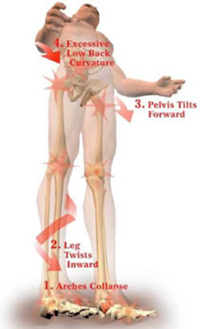
  • Pronation causes early wear and tear in the knee joints. Most commonly the medial joint space wears out and early signs of degenerative arthritis is very common.
  • If the lower leg rotates inward, the hip follows it. In excess, this can cause hip and low back problems.

What is an Orthotic?

  • An orthotic is a supportive device that is placed inside footwear, to change the mechanical function of the foot.
  • It works dynamically during weight-bearing activities like walking, running and standing.
  • Ideally, it should provide full, custom, and corrected arch support so that the foot works in a biomechanically correct way.
  • An orthotic controls the excessive flattening of the arch, thereby restoring normal bone and joint function.

Can Orthotics Prevent or Correct my Problems?

  • YES. If the problem is caught early enough, pain and deformity can often be prevented. Regular use of these unique orthotics can often reverse deformity development and prevent surgery.
  • vHOW? Because when you restore normal foot function you give your body what it needs to heal itself. It will also help hold your adjustments longer thereby, making them more effective.

Knee, Hip and Lower Back Pain and Dysfunction

Since the foot is the base of the lower kinetic chain, abnormalities here will translate up the leg, which will affect the pelvis. The pelvis is the base of the spine and enormously influences it’s function. With over-pronation of the foot, an abnormal torque at the ankle causes excessive internal rotation of the lower leg. This ultimately results in an excessive lordosis of the lumbar spine with pathological consequences – early degenerative changes.

Improves Balance, Coordination and Performance

  • Professional Athletes: The Denver Broncos, The New York Yankees, Andy Roddick and Tiger Woods are just a few of the many athletes who use orthotics to help improve their sports performance, balance, and power.
  • Diabetic Foot: Reduces shear forces and pressure points that helps avoid ulceration (where a non-diabetic foot would have a callus)
For further information or to set an appointment for evaluation to see if orthotics would benefit you and your specific concern, please call our office to schedule an evaluation and consultation. 

Get The Relief You Need Today. We Are Just A Call Away! 
9029022848


Resource:
http://www.olympicspine.com/the-importance-of-foot-evaluations-orthotics/